Be the smartest crook in the room
The Stalk Market is my solo tabletop game design project for CIS-5640 at Penn. Three to five players become shareholders in four absurd companies, secretly trading shares and anonymously manipulating the market. After five rounds, the player with the greatest total assets wins.
The theme treats ridiculous companies with complete financial seriousness. The design question is equally specific: how can a shared settlement phase become the moment everyone at the table cares about?
Trade, manipulate, react
- Forecast: reveal a public event that changes the conditions of the round.
- Action: players prepare trades and influence cards behind their screens, then commit together.
- Settlement: execute trades, reveal natural fluctuations, shuffle and resolve the anonymous influence pool, then reveal breaking news.
The signature mechanic is the influence pool. Every played card resolves, but its author is hidden. Players can follow what changed the market without knowing who caused it.
Designing the reveal
The market combines three sources of change: each stock's natural behavior, player influence and events. The four companies have deliberately different volatility profiles, giving players different kinds of uncertainty to think about.
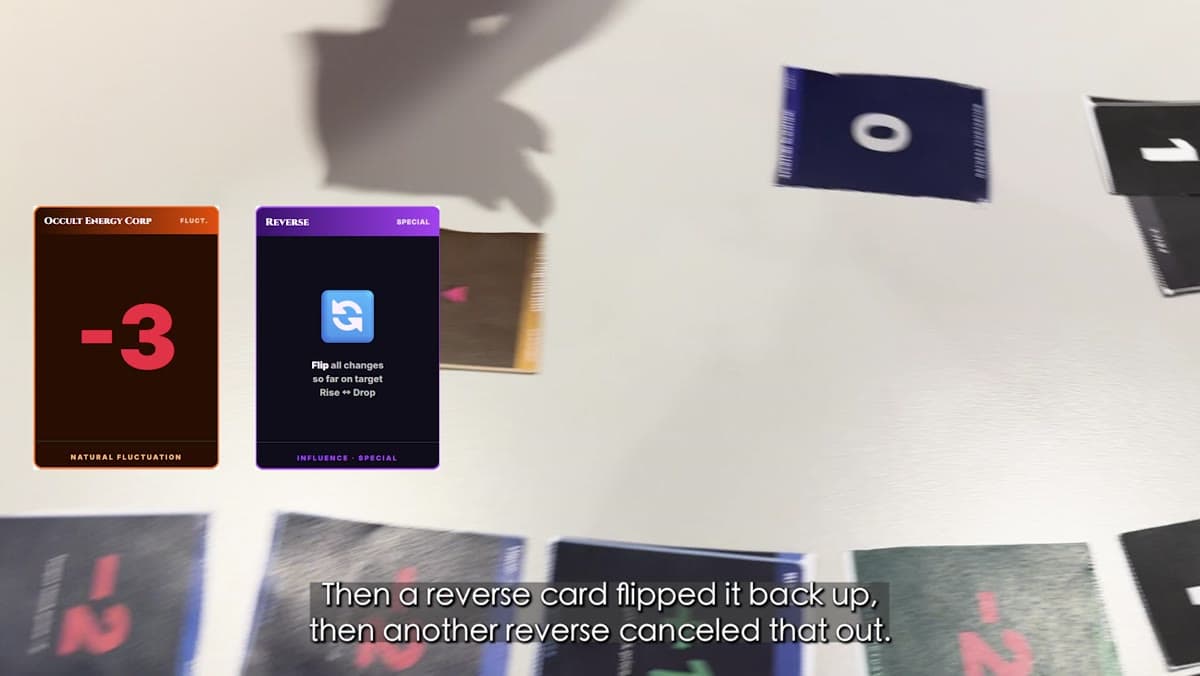
Revealing cards one at a time turns calculation into a shared event. A loss can become a gain, then reverse again. The goal is not only a strategic decision before the reveal, but a reason to watch everyone else's outcome.
Iteration and physical design
The design evolved from five stocks to four to reduce the information players track. An earlier version resolved only some influence cards at random; I changed this so every played card takes effect, preserving anonymity without discarding the player's action. Natural fluctuations moved after trading to keep the decision focused on anticipation.
I also designed printable cards, money, tokens, screens, action mats and target pockets. The screen doubles as a commitment signal: flipping it down over the mat locks in a player's choices.
A Python simulation explored contrasting trading strategies during development. Its numerical model belongs to an earlier rules iteration and is not evidence that the final game is fully balanced.
See it at the table
The recorded session demonstrates the core loop and settlement drama. Further playtesting would be needed to assess balance, pacing and the amount of component handling across different groups.
My role: game concept, rules, iteration, physical component design and presentation. An exploration in game design, not a digital trading product.